

Intumescent Pipe Collar CIPC (Fire Collar)
Plastic pipes that pass through fire-rated walls and floors create a vulnerability in compartmentation. When exposed to fire, combustible pipes soften and collapse, leaving a gap through which flames, hot gases and smoke can spread between compartments.
The PFC Corofil Intumescent Pipe Collar CIPC, also referred to as a pipe fire collar, is designed to seal that gap. A thin steel casing containing an intumescent lining is wrapped around the pipe at the point it passes through the wall or floor. In normal conditions it sits open. When heated in a fire, the intumescent expands rapidly, crushing the softened pipe and forming a fire-resistant seal that reinstates the integrity of the compartment.
The CIPC is available in sizes from 32mm to 250mm outer diameter, in 30mm and 40mm depths, and up to EI240 in rigid floors, up to EI120 in walls. It is suitable for single plastic pipes in flexible walls, rigid walls, rigid floors, and PFC Corofil Coated Panel systems. Compatible pipe types include: PVC-U, PVC-C, ABS, SAN+PVC, PE-HD, PE, PP.
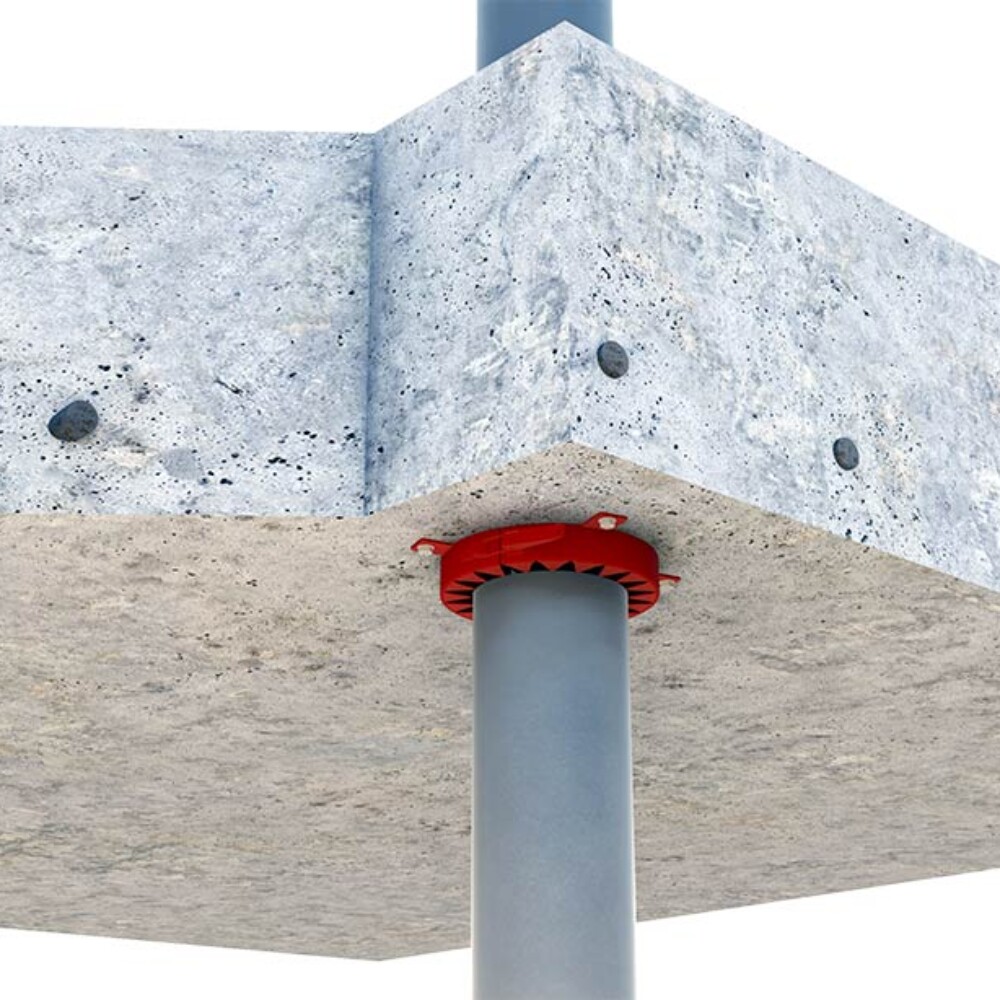
Sizing and Depth Guide
The CIPC is available in sizes to suit plastic pipes from 32mm to 250mm outer diameter, in 30mm and 40mm depths. Fire resistance performance is up to EI240 when installed on the underside of a rigid floor, and up to EI120 in flexible or rigid wall applications. Select the collar size by the outer diameter of the pipe to be protected, allowing a close fit without straining the collar. Collar dimensions and compatible pipe sizes are detailed in the technical data sheet.
The annular gap between the collar and the wall or floor surface should be sealed using PFC Corofil Acoustic Intumescent Sealant (CAIS).
| Plastic pipe outer diameter | Collar reference | Collar depth |
|---|---|---|
|
32mm |
CIPC 32mm x 30mm x 4mm |
30mm |
|
40mm |
CIPC 40mm x 30mm x 4mm |
30mm |
|
50mm |
CIPC 55mm x 30mm x 6mm |
30mm |
|
55mm |
CIPC 63mm x 30mm x 6mm |
30mm |
|
63mm |
CIPC 63mm x 30mm x 6mm |
30mm |
|
75mm |
CIPC 75mm x 30mm x 8mm |
30mm |
|
82mm |
CIPC 82mm x 30mm x 8mm |
30mm |
|
90mm |
CIPC 90mm x 30mm x 10mm |
30mm |
|
110mm |
CIPC 110mm x 30mm x 10mm |
30mm |
|
125mm |
CIPC 125mm x 40mm x 12mm |
40mm |
|
160mm |
CIPC 160mm x 40mm x 18mm |
40mm |
|
250mm |
CIPC 250mm x 40mm x 24mm |
40mm |
Where to use an Intumescent Pipe Collar?
Use the CIPC wherever a single combustible plastic pipe passes through a fire-resisting wall or floor. It is suitable for use in:
- Rigid walls: masonry, concrete and similar solid constructions
- Flexible walls: plasterboard partitions and drylining systems
- Rigid floors: concrete and similar
- PFC Corofil Coated Panel systems
It is not suitable for use with metal pipes (unless insulated; see datasheet), pipes in close proximity, or multiple pipes through a single penetration. For applications involving pipe wraps rather than collars, see the PFC Corofil Intumescent Pipe Wrap CIPW.
The CIPC has been tested to EN1366-3 and is third-party certified to UL-EU-01170-CPR. Compliance with Building Regulations Approved Document B requires that all openings for services through fire-separating elements are sealed with appropriate fire-stopping
BOOK AN EXPERT-LED CPD SESSION
This RIBA-accredited CPD seminar is for architects, specifiers, and contractors dedicated to creating safer, compliant, and future-ready buildings

Key points:
- Available in sizes from 32mm to 250mm outer diameter
- 30mm and 40mm depths available. Fire resistance up to EI240 in rigid floors, up to EI120 in walls.
- Tested to EN1366-3. Suitable for flexible walls, rigid walls, rigid floors, and PFC Corofil Coated Panel systems
- Suitable for use with plasterboard partitions
- Intumescent steel casing: supplied assembled without fixings
- Third-party certified: UL-EU-01170-CPR
- Seal annular gap with PFC Corofil Acoustic Intumescent Sealant (CAIS)
Frequently Asked Questions
An intumescent pipe collar is a passive fire protection device that seals plastic pipe penetrations through fire-rated walls and floors. When a combustible plastic pipe passes through a fire-rated element it creates a weak point in compartmentation: in a fire the pipe softens and collapses, leaving a gap through which flames, hot gases and smoke can spread between compartments.
The collar closes that gap. A thin steel casing containing an intumescent lining wraps around the pipe where it passes through the wall or floor. In normal conditions it sits open and the pipe functions as usual. When heated in a fire the intumescent expands rapidly, crushing the softened pipe and forming a fire-resistant seal that reinstates the integrity of the compartment.
The PFC Corofil CIPC is tested to EN1366-3 and third-party certified to UL-EU-01170-CPR. It achieves fire resistance of up to EI240 in rigid floors and up to EI120 in flexible and rigid walls, is available in 15 sizes from 32mm to 250mm outer diameter, and is compatible with PVC-U, PVC-C, ABS, SAN+PVC, PE-HD, PE and PP pipes. It is one product in the PFC Corofil service penetration seals range.
The PFC Corofil CIPC is available in 15 sizes to suit plastic pipes from 32mm to 250mm outer diameter: 32, 40, 50, 55, 63, 75, 82, 90, 100, 110, 125, 140, 160, 200 and 250mm, in 30mm and 40mm depths. Compatible plastic pipe materials are PVC-U, PVC-C, ABS, SAN+PVC, PE-HD, PE and PP.
Select the collar by the outer diameter of the pipe to be protected; it should fit closely without straining the pipe, so the intumescent can exert sufficient closure pressure in a fire. Fire resistance is up to EI240 when installed on the underside of a rigid floor and up to EI120 in flexible or rigid walls.
The specific collar reference, wall thickness requirements and compatible pipe wall thicknesses for each size and substrate are set out in the technical datasheet. Where a surface-fixed collar is not practical, see the PFC Corofil Intumescent Pipe Wrap CIPW.
Yes. Plastic soil and waste pipes are one of the most common uses for an intumescent pipe collar. The PFC Corofil CIPC has been tested on PP soil and waste discharge pipe (EN1451), as well as PVC-U and PE pipe, across sizes from 32mm to 250mm outer diameter, including the 110mm size typical of soil stacks.
In floors, the collar is fixed to the underside of a rigid floor at least 150mm thick and achieves up to EI240. In walls at least 100mm thick, a collar is fixed on each side and achieves up to EI120. Pipe wall thickness limits apply to each size, so check the pipe against the technical datasheet before specifying.
The CIPC is designed for combustible plastic pipes. It works because a plastic pipe softens and collapses in a fire, allowing the expanding intumescent to crush it and close the opening. Bare metal pipes such as copper or steel do not collapse in the same way, so a collar is not the right seal for them.
The technical datasheet sets out the only applications the CIPC has been tested in, so check it before using the collar on insulated metal pipe. For insulated metallic pipework, see the PFC Corofil Universal Pipe Wrap CUPW, which is suitable for combustible and metallic pipes with insulation, or PFC Corofil Insulated Fire Sleeves CIFS for metal and plastic pipes.
The CIPC achieves up to EI240 when fixed to the underside of a rigid floor at least 150mm thick, and up to EI120 in flexible and rigid walls at least 100mm thick, with a collar fixed on each side of the wall. It also achieves EI120 in PFC Corofil Coated Panel systems.
E stands for integrity and I for insulation, and the number is the fire resistance period in minutes. Most classifications are U/C (pipe end uncapped inside the furnace and capped outside), which is the configuration that represents soil, waste and drainage pipework. Ratings are from testing to EN1366-3, and the collar is third-party certified to UL-EU-01170-CPR. The rating for each pipe material, size and substrate is set out in the technical datasheet.
Intumescent pipe collars and pipe wraps do the same job, sealing a combustible plastic pipe penetration through a fire-rated wall or floor, but they differ in how and where they are installed.
A pipe collar is a pre-formed steel casing supplied assembled. It wraps around the pipe and fixes to the surface of the wall or floor at the penetration point, on one side for floors and both sides for walls, and suits installations where the pipe is already in place, where access to the wall thickness is limited, or where the penetration needs to stay accessible for inspection.
A pipe wrap, such as the PFC Corofil Intumescent Pipe Wrap CIPW, is an intumescent strip wound directly around the pipe within the thickness of the wall or floor, built into the construction at the point of installation, and is typically specified where a surface-fixed collar is not practical or the fire strategy requires a different configuration.
For most standard service penetrations through plasterboard partitions, masonry walls and concrete floors, the PFC Corofil CIPC collar is the appropriate solution. Both products are tested to EN1366-3, and the correct product for a given application should always be confirmed against the relevant performance data and the project fire strategy. See the full service penetrations range for related products.
Yes. Building Regulations Approved Document B requires that openings for services through fire-separating elements are sealed with appropriate fire-stopping to maintain compartmentation. Where a combustible plastic pipe passes through a fire-rated wall or floor, the opening must be sealed to reinstate the fire resistance of that element, and a tested, certified intumescent pipe collar is an accepted method of achieving this.
The obligation applies to the responsible person under fire safety legislation and to building control sign-off on new builds and major refurbishments. For residential buildings over 18m and for higher-risk buildings defined under the Building Safety Act 2022, the requirements are more stringent and the fire strategy should specify the required performance level explicitly.
Any product used must be tested for the specific configuration in which it will be installed, including pipe material, pipe size, substrate type and collar orientation. The PFC Corofil CIPC is tested to EN1366-3, third-party certified to UL-EU-01170-CPR, and achieves up to EI240 in rigid floors and up to EI120 in walls, with performance data for all tested configurations in the technical datasheet. Explore other service penetration seals for different penetration types.
Seal the annular gap between the collar and the wall or floor surface with PFC Corofil Acoustic Intumescent Sealant CAIS before fixing the collar in place. The annular gap is the space between the outside of the pipe and the edge of the aperture, and the maximum permitted gap is 10mm.
Apply the CAIS before the collar is slid into position against the separating element. Once the sealant is in place and the collar sits flush against the surface, fix the collar through each of the three lugs using the correct fixings for the substrate: toggle anchors for flexible walls; FSA bolts, wood screws or hammer fixings for rigid walls and floors; and pigtails for PFC Corofil Coated Panel systems.
Apertures for pipe penetrations must be at least 200mm apart. Services in walls must be supported at a maximum of 400mm from the face of the separating element on both sides, and services in floors at a maximum of 400mm from the top surface. Full fixing details and substrate-specific performance data are in the CIPC technical datasheet.
Make an enquiry